

The clinical record, dictated from inside the ambulance
Paramedics used to write the record of a transfer by hand and someone else typed it in later. Now they dictate the form and Cyntia transcribes it, reads the intent and fills in every field.



A paramedic has both hands busy. Until now the record of what happened on the way to the hospital was written on a notepad, at a red light or once the ambulance had already arrived — and then typed again into a form by someone who was not there.
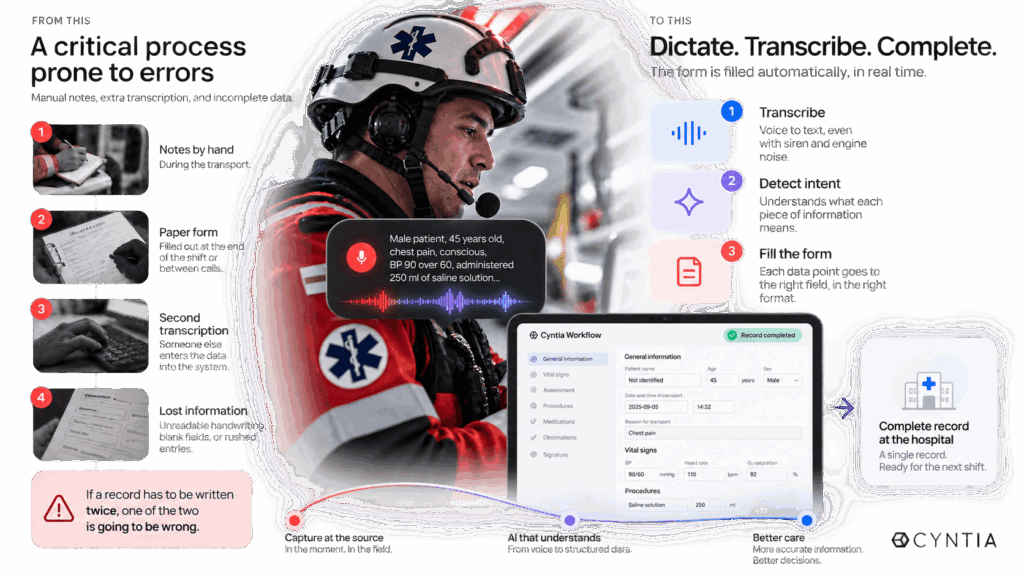
What the process used to be
The clinical record of a transfer is not paperwork: it is the account of what was found, what was administered and how the patient responded. It is written under time pressure, with gloves on and inside a moving vehicle.
- Handwritten notes on a notepad during the transfer.
- A form filled in by hand, at the end of the shift or between calls.
- A second person transcribing that handwriting into the system.
- Fields left blank because nobody could read them, or because the shift ended first.
Every one of those steps is a place where information is lost. And the further away from the moment of care, the harder it is to recover.
What it is now
The form is digital and the paramedic dictates it. They speak as they would to a colleague — no set order, no field names, no commands to memorise — and Cyntia Workflow receives the audio while Cyntia Intelligence does three things with it:
It transcribes
Speech to text, on the move, with the noise of a siren and an engine in the background.
It reads the intent
It is not a search for keywords. The system understands what part of the record each sentence belongs to, so the paramedic can jump back to something they said earlier without starting over.
It fills in the form
Each piece goes to the field it belongs to, in the format that field expects: a vital sign as a number, a time as a time, a medication with its dose.
What arrives at the hospital is a complete record, written at the moment of care by the person who was there.
What changes
- The record is written while it happens, not reconstructed from memory afterwards.
- There is no second transcription, so there is no second place to introduce an error.
- Both hands stay free. Dictating does not compete with caring for the patient.
- Nothing depends on handwriting. What reaches the next shift is legible because it was never handwritten.
Where it fits
This is field data capture: the form travels to where the work actually happens instead of waiting at a desk. The same approach works anywhere the record is written standing up and with your hands busy — an inspection, a site visit, a delivery, a repair.
If the record has to be written twice, it will be written badly once.