

Fraud signals in the call and in the file, before the payout
Two fronts with the same principle. One model analyses the call in which a motor claim is reported; another checks medical authorisations against the diagnosis on record. Neither decides: both mark the case so a person reviews it.



Fraud rarely announces itself in a single document. It shows up as a set of signals that are individually unremarkable and, taken together, are not — and no reviewer can weigh them across every claim that arrives in a day. Cyntia applies that reading on two fronts, with the same principle behind both.
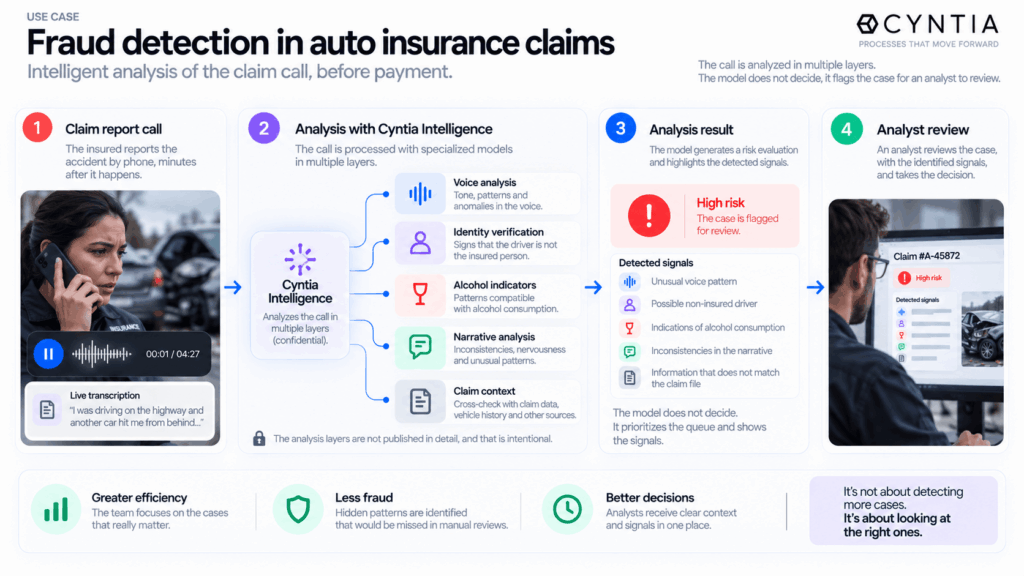
Motor: the report call
The call in which a claim is first reported is the richest evidence an insurer will ever have about it, and the least examined. It is made minutes after the event, before any account has been rehearsed.
A dedicated model analyses that call in several layers. Among them: voice analysis, indications that the person driving was not the person insured, signs of intoxication, and stress markers in the account itself.
The layers are not published in detail, and that is deliberate. A detection method described in full is a method that can be worked around. What is published is what the insurer gets: a claim that arrives already read.
Medical expenses: authorisation against diagnosis
On the health side, the model reads the authorisations submitted to the insurer and checks their internal consistency: do the procedures, medications and tests being requested correspond to the diagnosis on record?
A request that does not line up raises a flag on the case, so that it can be reviewed in depth.
What the model does, and what it does not
This distinction is the whole design, not a caveat at the end of it.
- It does not decide. No claim is denied and no case is closed by a model.
- It does not accuse. A signal is a reason to look, not a conclusion about a person.
- It orders the queue. The reviewer opens the cases that carry signals first, and opens them already knowing which ones they are.
Fraud review is normally limited by how much a team can examine. Reviewing by sample means most cases are never looked at and the ones that are, are chosen at random. Reviewing by signal means the team spends its hours where there is something to find.
The point is not to catch more claims. It is to look at the right ones.
Where it applies
The pattern holds wherever a claim is supported by a statement and a set of documents that ought to agree with each other: a loss report, a warranty claim, a reimbursement, an expense settlement. The account is read, the documents are read, and what does not add up is marked for a person to examine.