

Every call reviewed, not the three someone had time for
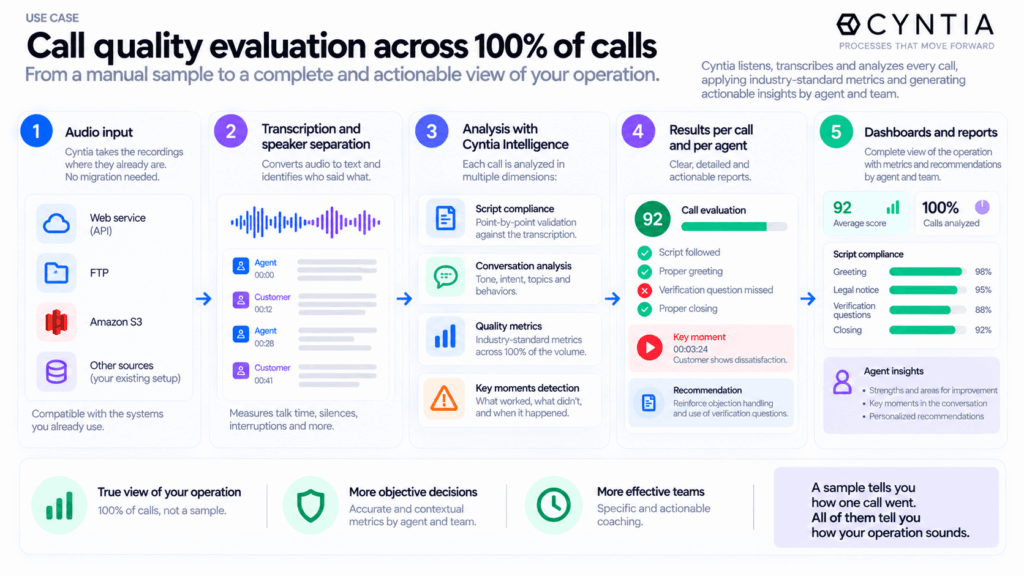
Quality teams score a sample and report a number for the whole operation. Cyntia transcribes every call with the speakers separated, verifies the agreed script against what was actually said, and returns metrics, strong and weak points, and recommendations per agent.



A quality team listens to a handful of calls per agent per month, fills in a form and assigns a score. Everything else — thousands of conversations — is never heard by anyone. Not because it does not matter, but because there are not enough hours in a month to hear it.
So the report says the operation scored 92. What it actually says is that 1% of it scored 92.
Every call, not a sample
Cyntia reviews all of them. The standard industry metrics are produced for the entire volume, not for the calls a supervisor happened to pick — which means the number finally describes the operation instead of describing a selection.
The change is not that the score gets better. It is that the score becomes true.
What it hears
The conversation, with each speaker separated
Transcription identifies who said what. A call is not a wall of text: it is one person and another, taking turns. Once the turns are separated, everything that depends on them can be measured — among them how much each side spoke, where the silences fell, and who talked over whom.
The agreed script
Every operation has a script agreed with the client: the greeting, the disclosure that must be read, the verification questions, the closing. Cyntia checks it against the transcript, not against the agent’s memory — and not against the supervisor’s either. Delivered, partially delivered, or skipped, on every call.
What worked and what did not
For each call: the strong points, the weak ones, and the specific moment where the conversation turned. A score tells a supervisor which agents to worry about. This tells them what to say when they sit down with one.
What it returns
- Metrics — the industry standards, over 100% of the volume.
- Script compliance — point by point, call by call.
- Strong and weak points, with the moment they occurred.
- Improvements and recommendations, per agent, drawn from their own calls rather than from a generic checklist.
It connects to the audio where the audio already is
Recordings rarely live in a convenient place, and moving them is its own project. Cyntia takes the input as it comes: a web service, an FTP drop, an S3 bucket, or whatever the operation already uses. Nothing has to be migrated for the review to start.
What changes
| Before | With Cyntia | |
|---|---|---|
| Coverage | A sample chosen by hand | 100% of calls |
| Script compliance | Judged from memory, on the sampled calls | Verified against the transcript, on every call |
| Feedback | A score and a form | The moment it happened, and what to do about it |
| Integration | Move the audio somewhere new | Web service, FTP, S3 — where it already is |
A sample tells you how one call went. All of them tell you how your operation sounds.
Where it applies
Anywhere a conversation is the service and not just the channel: collections, sales, support, retention, appointment setting. If someone is judged on how a call went, the call can be read.