

Repair shop invoices, validated the moment they are submitted
A motor insurer received invoices from repair shops within a twenty-day window and validated each one by hand. Cyntia now reads the invoice, checks it against the claim and against the tax authority, and resolves it in five minutes.



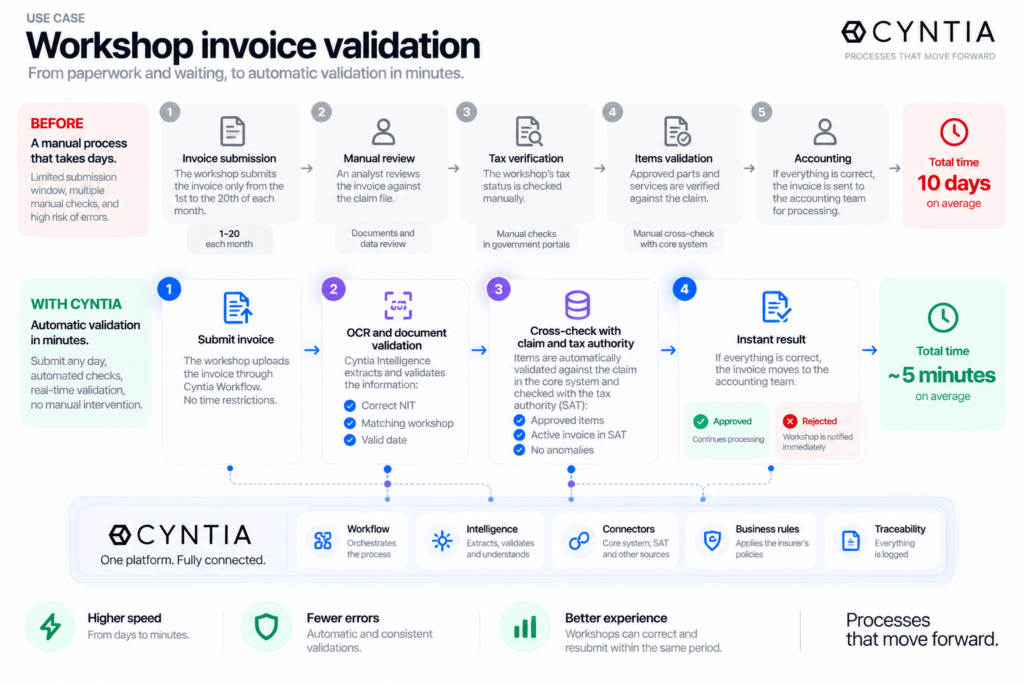
For a motor insurer, the invoice is the last step of a claim and the one that sets the pace of the rest. Repair shops could submit invoices only between the 1st and the 20th of each month; each one was then validated by hand against the claim file, the shop’s tax records and the approved repair items. The operation took ten days.
How the process works
The repair shop submits the invoice and the validation runs on its own. Nothing waits for an analyst to open the file.

1. Submission
Once the vehicle repair is complete, the shop submits the invoice through Cyntia Workflow. There is no submission window and no intermediary: the document enters the process at the moment it is issued.
2. Validation of the document
Cyntia Intelligence applies OCR to the invoice and examines the extracted data before accepting it:
- That it was issued to the correct tax identification number (NIT).
- That it belongs to the repair shop submitting it.
- That it falls within the valid date range.
3. Cross-validation against the claim and the tax authority
The line items on the invoice are then checked against the insurer’s core system: are these items approved for this specific claim? An invoice with items that were never authorised is rejected at that point, not weeks later.
If the items are approved, Cyntia Intelligence verifies with the tax authority (SAT) that the invoice was properly issued and has not been voided. An invoice that clears every check is passed to accounting and continues its normal course.
What changes
| Before | With Cyntia | |
|---|---|---|
| Submission window | The 1st to the 20th of each month | Every day, up to the accounting close |
| Validation | A ten-day manual operation | Autonomous, five minutes on average |
| Rejections | Identified late in the cycle | At the moment of submission |
The gain is not only speed. A rejection that arrives within minutes is a rejection the shop can still act on: it can correct and resubmit within the same accounting period, instead of carrying the invoice into the next one.
Where it applies
The pattern holds wherever a third party submits a document that must be validated against several sources before it can be paid: a supplier invoice, an expense report, a service settlement. The document arrives, the rules are applied, and only what is correct moves forward.